

The GTM Engineering Playbook For The AI Era
Automations are outperforming agents – here's what you need to know to use GTM Engineering to your advantage.


Our social feeds have been overrun with talk of AI agents, but I actually think teams are spending too much time fixating on AI. There’s not a single client I’ve worked with in the last 18 months that wouldn’t benefit more from setting up automations. Yes, You still have to be on top of AI, but I think the better ROI right now that are more sustainable are coming from the work that GTM engineers are doing, building automation.
The average B2B SaaS company now spends $2 on sales and marketing to drive #1 new ARR, up 14% from last year. But boards aren’t approving headcount to help you make up the difference. They’re demanding the same growth from a leaner team, which means the work has to come from systems that run without a person babysitting them. That’s the exact job the GTM engineer was invented for.
Clay put a name to the role in 2023, and around 100 GTM engineer listings now go live every month, which tells you how quickly companies realized they need this skill on the team.
Don’t get me wrong, I’m not saying don’t use AI agents, because if you’ve been following me, I talk a lot about that. However, the best and most effective GTM teams first built tight, predictable automations first, and they layer in AI as one ingredient inside those systems instead of the foundation.
As usual, I wrote this issue be actionable and practical. The goal is to get you past using Clay for enrichment and into building actual GTM workflows, so you can automate the parts of marketing that should be automated and spend your own hours on the parts only a human can do. Anthony Kennada put it well on LinkedIn: “But the inputs on the front end of building the brand, as well as the activation outputs on the other end of the prompt, is where we find our craft as human marketers.”
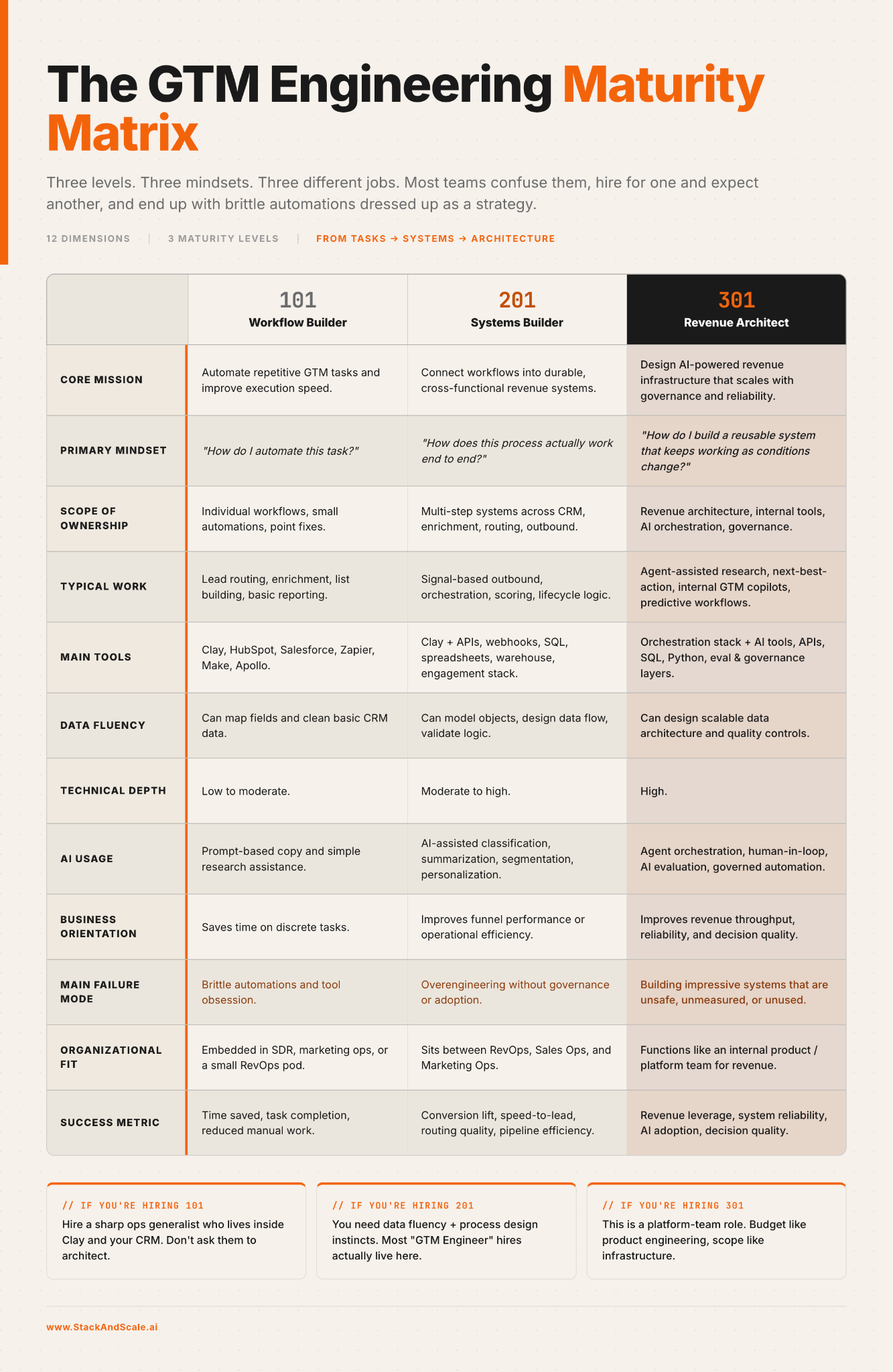
GTM Engineering Maturity Model
101: Workflow Builder
A 101 GTM Engineer is mostly a high-agency operator who can create reliable automations inside a narrow scope: CRM hygiene, routing, enrichment, list building, basic outbound support, and reporting. The starting point is simply getting comfortable with Clay, formula columns, enrichments, and simple company/person workflows.
What defines 101
Builds single-purpose automations with clear inputs and outputs.
Works mostly inside tools rather than across systems.
Solves immediate pains: manual research, routing errors, bad data, repetitive outbound prep.
Thinks in tasks, not architecture.
Typical use cases
Lead routing rules.
Enrichment waterfalls.
Prospect list building.
Simple outbound personalization prompts.
Basic dashboards and CRM cleanup.
201: Systems Builder
A 201 GTM Engineer moves from isolated workflows to multi-step systems that connect data, signals, routing, segmentation, and outbound motion. This is where signal-based selling, data orchestration, and cross-functional collaboration start to matter more than pure tool fluency.
What distinguishes 201
Designs end-to-end process flows, not just automations.
Understands how data moves through the revenue engine.
Uses AI selectively to speed research, classification, and decisioning.
Partners closely with RevOps, Sales Ops, and Marketing Ops.
What defines 201
Signal-based account prioritization tied to routing and outbound.
Buying committee mapping from company + people + intent data.
SLA-aware lead handling across marketing and sales.
Automated prospect research briefs for reps.
Lead scoring pipelines that combine structured and unstructured signals.
Where a 101 practitioner is automating tasks, a 201 practitioner asks, “What is the system, where does it break, what signal should change the next action, and how do we keep it governable?” That systems view is a recurring theme in practitioner commentary about GTM Engineering as the “glue layer” between RevOps and product-like execution.
301: Revenue Infrastructure Architect
A 301 GTM Engineer is building AI-powered revenue infrastructure – reusable internal products, agent-assisted operations, orchestration logic, and strategic revenue architecture. I think of this level as a hybrid of product management, data engineering, automation engineering, and RevOps leadership.
What defines 301
Owns the architecture of the revenue system, not just individual automations.
Designs human-in-the-loop and agentic workflows with control points, caching, fallbacks, and governance.
Treats GTM logic as an internal product with lifecycle, QA, instrumentation, and adoption.
Thinks in terms of scalability, reliability, and compounding leverage.
Typical use cases
Autonomous prospect research pipelines with guardrails.
Agent-assisted account prioritization and next-best-action systems.
Personalized outbound generation that adapts to buying signals.
Revenue intelligence systems that detect leakage, risk, and opportunity in real time.
Internal GTM copilots for reps, managers, and operators.
At this level, it’s a system where AI handles research, summarization, classification, drafting, and triage, while humans supervise policy, exceptions, and strategic decisions. Glean’s RevOps guidance and other AI-in-RevOps examples emphasize secure workflows, governance, and human review rather than full autonomy.
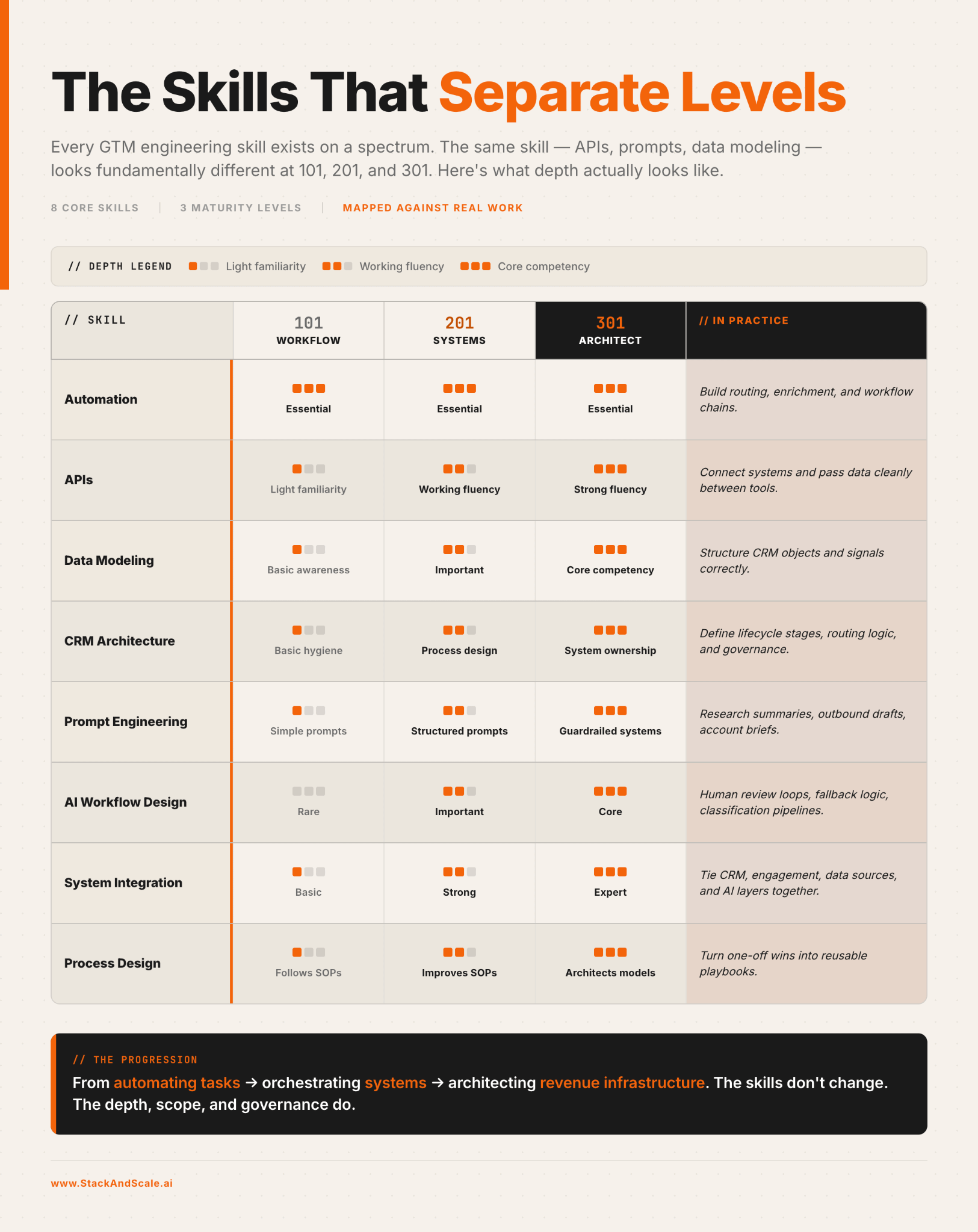
Skills by GTM Engineering Level
A GTM engineer starts with practical operator skills: being fluent in the CRM, understanding funnel math and revenue metrics, and being able to build clean workflows in tools like Clay, HubSpot, Zapier, or n8n.
At the 101 level, the focus is on reliability and execution. At 201, those same skills deepen into SQL, API literacy, data modeling, and system design so you can connect workflows across tools and improve pipeline quality. And at 301, the role expands into architecture, automation governance, Python or scripting, and AI workflow design, where the job is less about building one-off automations and more about designing durable revenue infrastructure that scales and adapts.
10 High-Impact Automation Plays You Should Build Today
Okay, now on to the part that I think most people will skip directly to. The actual plays and use cases.
1. Anonymous website visitor to account routing
Start by deciding which pages count as high-intent, usually pricing, comparison, alternative, integration, or demo pages. Then set up a visitor signal source and route those visits into a staging layer where you can match the anonymous company to your CRM, remove existing customers, and check ICP fit before anyone gets alerted. Once the account clears qualification, push it to Slack, create a task for the owner, or enroll it in a campaign; then track whether those alerts turn into meetings or pipeline so you can refine the page list and scoring rules over time.
2. Pricing-page visitor to personalized nurture
Build this by first tagging pricing-page and high-intent product-page visits, then enriching the company and contact record so you know who this is and whether they fit your target segment. Next, create a branching nurture path based on the likely objection: price sensitivity, implementation risk, missing features, or competitive comparison, and only generate the message after you have the framework and proof points in place. The key GTM engineer move is to qualify before generating, because AI is much better at drafting the message than deciding whether the account deserves one.
3. Competitor research signal to ABM activation
Start by defining which signals count as competitor research, such as visits to alternative pages, comparison content, review sites, or related intent data. Then enrich the company, map the likely buying committee, and segment the account into the right campaign path so marketing can launch targeted ads, email, or sales alerts without waiting for a form fill. The workflow should end with a measurement layer that tells you whether competitor-intent accounts move faster or convert better than the rest of your audience.
4. Job-change trigger to account reactivation
Pull in job-change signals from your data source, then check whether the person already exists in your CRM and whether their new company is in your target market. If they are relevant, enrich the new company, reconnect the contact history, and decide whether the next action is a warm congratulations email, an internal alert to an owner, or a reactivation sequence for the new account. This workflow works best when you treat the job change as a reason to reassess account status, not just as a contact update.
5. Funding-round trigger to campaign launch
Set up a funding signal, then create a filter that checks company size, stage, geography, and ICP fit so you do not launch campaigns into irrelevant companies. After enrichment, route the account into a campaign cluster based on stage, because a Series A company needs different messaging than a late-stage company with a mature stack and different buying constraints. The best GTM engineers also define the action layer in advance: email, retargeting, SDR alert, or all three, depending on account value and urgency.
6. Technographic change to persona-specific messaging
Build this workflow by monitoring for meaningful tech stack changes, especially installs, removals, or replacements of tools that relate to your category. Then enrich the account and determine whether the change implies switching pain, integration risk, compliance pressure, or expansion opportunity, and use that to branch the campaign logic. Once the account is classified, generate persona-specific messaging blocks so marketing can speak differently to an operator, a technical evaluator, or an economic buyer.
7. Content-engagement scoring to MQL or SQL prioritization
Instead of scoring every touch in isolation, define a weighted engagement model that distinguishes casual readers from real buyers. Pull in the events you care about, such as webinar attendance, repeated page visits, gated content downloads, and return sessions, then calculate a rolling score and map that score to lifecycle stage or routing rules. In practice, the GTM engineer’s job is to make sure the score is tied to real downstream action, not just a dashboard metric that nobody uses.
8. Dark-funnel account list builder
This workflow starts with a hypothesis about what an in-market account looks like, then pulls together weak signals from web behavior, hiring, funding, technographic changes, and content engagement. After that, you enrich and score the accounts, suppress bad-fit records, and output a prioritized list that can feed paid, outbound, or partner motions. The practical value here is that marketing stops waiting for explicit intent and starts activating against a pattern of behavior that strongly suggests interest.
9. Webinar attendee to sales-assist workflow
Build the workflow around registration and attendance data, but separate live attendees, no-shows, and high-engagement participants into different branches. Then enrich the attendee records, tag them by topic interest or company fit, and push each segment into a follow-up motion that matches the behavior they showed during the event. A strong version of this system also generates a rep-facing summary so sales knows which attendees were worth prioritizing and why.
10. AI-generated account brief for marketers and reps
This workflow should begin only after the account has been qualified by signal and fit, not before. Once the account clears that threshold, gather firmographic, technographic, people, and activity data, then feed it into an AI step that generates a short brief with the account’s context, likely pain points, and recommended next actions. The GTM engineer’s role is to make the prompt and guardrails specific enough that the output is useful, brand-safe, and grounded in evidence rather than generic AI prose.
Conclusion
The most useful way to build these is to follow the same sequence every time: trigger, qualification, enrichment, action, measurement. If you keep that pattern consistent, the individual workflow can change without your entire operating model becoming brittle.
The strongest teams also centralize logic and distribute execution, which means they define scoring, routing, and playbook rules once, then push the outputs into CRM, Slack, email, ads, or browser-based tools where the team actually works. That is the real GTM engineering skill: not just stitching tools together, but turning signal into repeatable revenue motion.
I think this is also the most direct path to becoming indispensable in your company over the next couple of years, and I don’t say that lightly. The efficiency math I opened with isn’t easing up. Every leader is being asked to grow revenue without growing headcount in step. The person who can look at a manual, expensive motion and rebuild it as a system that runs while everyone sleeps becomes the person the company can’t operate without. That ability has almost nothing to do with which tools you know. It comes from how you see the business.