

The New Job Search Playbook in the AI Era
A step-by-step guide for running a human-led, AI-enabled system for landing your dream job


I spend most of my week building pipeline for B2B SaaS companies, and I leaning on AI to help.
Then a friend asked me to help with their job search, and I watched a sharp marketer run a very unorganized process (which is probably the case for most job hunters). And yes, he was using AI, but only to write emails and do some job interview prep. So, of course, my performance-marketing brain got the better of me.
I decided I’d build an AI system, packaged the whole thing as Claude Code skills, and put it on GitHub (get it here). In this issue of Stack & Scale, I’ll walk you through installing it and running it.
One assumption up front, though, is that you already run Claude Code. If you don’t, get it first, learn some basics, then come back to the repo.
What makes this system different
This is NOT about creating swarms of agents that auto-apply to 500 roles overnight so you wake up to booked interviews. That product exists, and I don’t actually think that’s effective at all. It’s also the reason every recruiter’s inbox is filled with junk and cold applying to jobs barely works, even worse than it did pre-AI.
The system that I built here (I call it the Search & Scale OS) is human-led, but AI-enabled. It sources, scores, researches, drafts, and recommends. So yea, you still have to put in the work, but that also (hopefully) means that nothing is sent out that you didn’t look at (i.e., no AI slop!).
This system is built on two beliefs.
Referral-first is still how you are most likely to land a job. If you’ve followed me for some time, you know this is what I strongly believe in. A warm intro beats a cold application every time (when I was working for a hiring data company, a chief talent officer at a top B2B SaaS company told me they have over 2 million unread applications!). A referral is worth more than it’s ever been. So, this system warms every high-priority intro before and after you apply.
But you still need volume. Just like marketing with AI, job search with AI helps you scale faster, as long as you have a good and proven foundation. And I’ve seen genuinely talented marketers run a programmatic application search and land at a fast-growing AI company without a referral.
So, this system runs on both a referral play and a volume play, and I made sure to build in quality evals so neither one puts slop into the world with your name on it.
There are three rules that I built into every skill.
Nothing fabricates experience, numbers, or credentials, so your gaps stay visible and you decide how to handle them.
Nothing auto-applies or auto-sends.
Everything lives in plain text on your machine, no account and no cloud.
Set that expectation now, because it shapes every step below.
Ok, with that out of the way, let’s dive into the system.
Install it
My system is 17 Claude Code skills plus a workspace/ folder. You don’t have to worry about databases or API keys.
Clone the repo and copy the skills into your personal skills directory:
git clone https://github.com/guerrilla2799/search-and-scale-os.git
cp -R search-and-scale-os/skills/* ~/.claude/skills/
Then you’ll have to restart Claude Code to use the skills. And that’s the whole install!
If you’d rather keep the search self-contained, clone it and work inside the folder instead, and everything you generate stays alongside the skills in workspace/.
Your first command is always the same: Use the job-search-setup skill.
One privacy note before you run anything real. Your resume, your target list, and your application notes all land in workspace/. Keep that folder local, or add it to .gitignore before you commit. The public repo ships only the empty scaffold.
How to run it
Instead of running all 17 skills in a row, you loop them, and then the system orchestrator tells you what’s next based on the status of your pipeline. The first time through, though, there’s a clear order to it. For each stage, here’s what you run, what you get back, and the one thing to remember.
Set the foundation
Run job-search-setup. This imports your resume, then interviews you to fill in what the resume doesn’t cover, like what you actually want, your comp floor, the roles you’re targeting, and a tiered list of target companies (if you have one).
This is one of the more tedious steps, but you can’t skip it because it really sets the foundation that everything else relies on. In other words, don’t rush this. Take your time and give the system more quality inputs so you can get better quality outputs. I would recommend spending at least 30 minutes here.
Fill the pipeline, then rank it
Now you need roles, and then you need to know which you should spend your time on.
Run job-sourcing to pull open roles that you told the system you’re targeting from company and ATS pages and the boards, deduped and screened for scams. Then run job-fit-scoring, which scores each role from 0 to 100 against your profile and sorts them into A, B, or C priority.
The scored output is the point. A slice of it looks like this:
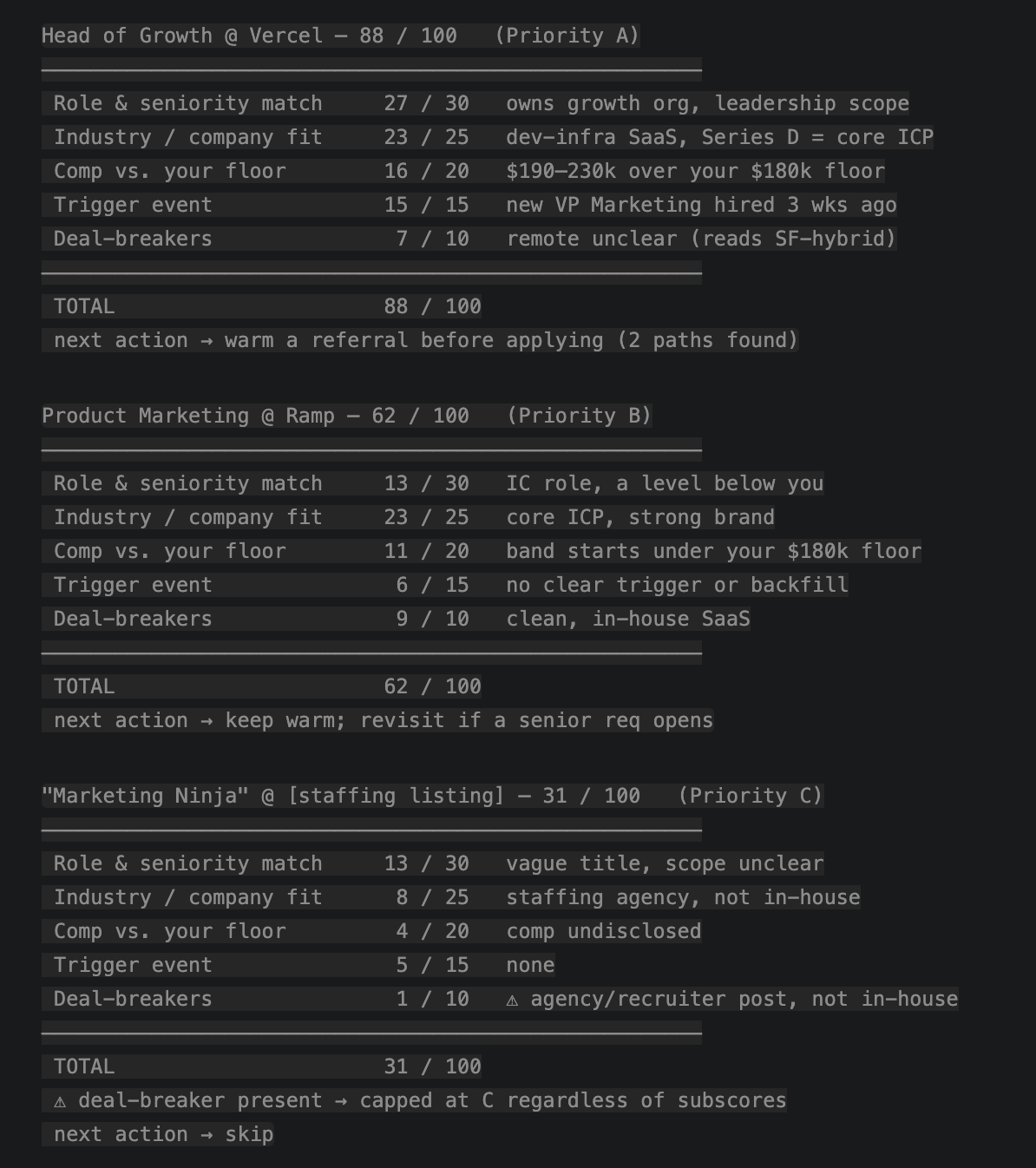
When you look at this, it’s pretty obvious to you that Head of Growth at Vercel is a great opportunity and the Marketing Ninja is not. But it might not be as obvious to an AI, which is why we put the whole scoring system in place.
Warm the path before you apply
Next, run company-research on your A-roles first. This is going to give you a dossier on the company and the people you could potentially interview with. Then run networking-and-referrals, which takes a target company and works out the warmest path in you actually have, then drafts the ask.
Warm intros are your best path into any company. So the rule that this step hinges on is no A-role goes out cold without a referral or at least a potential path. This will take a little judgment from you, but it’s going to surface a bunch of angles and options.
The 20-30 minutes it takes to find someone who’ll vouch for you is worth more than 15 more cold applications. If you’re running the volume play on your B-tier instead, that’s fine, the system is also built for that – the quality eval still works.
Apply
Now we’re going to tailor our message. As any good marketer knows, you’ve got to speak the language of your audience.
Run resume-tailor for a resume matched to the specific job description. Now, we are going to keep it honest and not lie about your skills or qualifications because we want to stay at the job that we land. Run cover-letter for a one-page letter built on an actual story, addressed to a real person, that opens with an angle instead of “I am writing to express my interest.”
Now, in full transparency, I have slammed cover letters before. However, I do think that, done correctly, they can be a powerful tool. As a hiring manager, I get fewer cover letters, so when I get one, you get an extra few seconds of my attention. And if it’s a good one, then you can actually stand out, but make sure it’s personalized and relevant.
You never see the first version of the resume or the cover letter either. Both drafts are run through two quality checks skills first. The writing-quality skill strips the AI tells and the sentences that sound like every other model on earth wrote them, because they did. Then artifact-eval scores the piece against a rubric and revises until it meets our standards.
Track, interview, negotiate
Now remember I said we’re running this like pipeline process because it is a pipeline but just a different kind. The application-tracker acts as your local CRM.
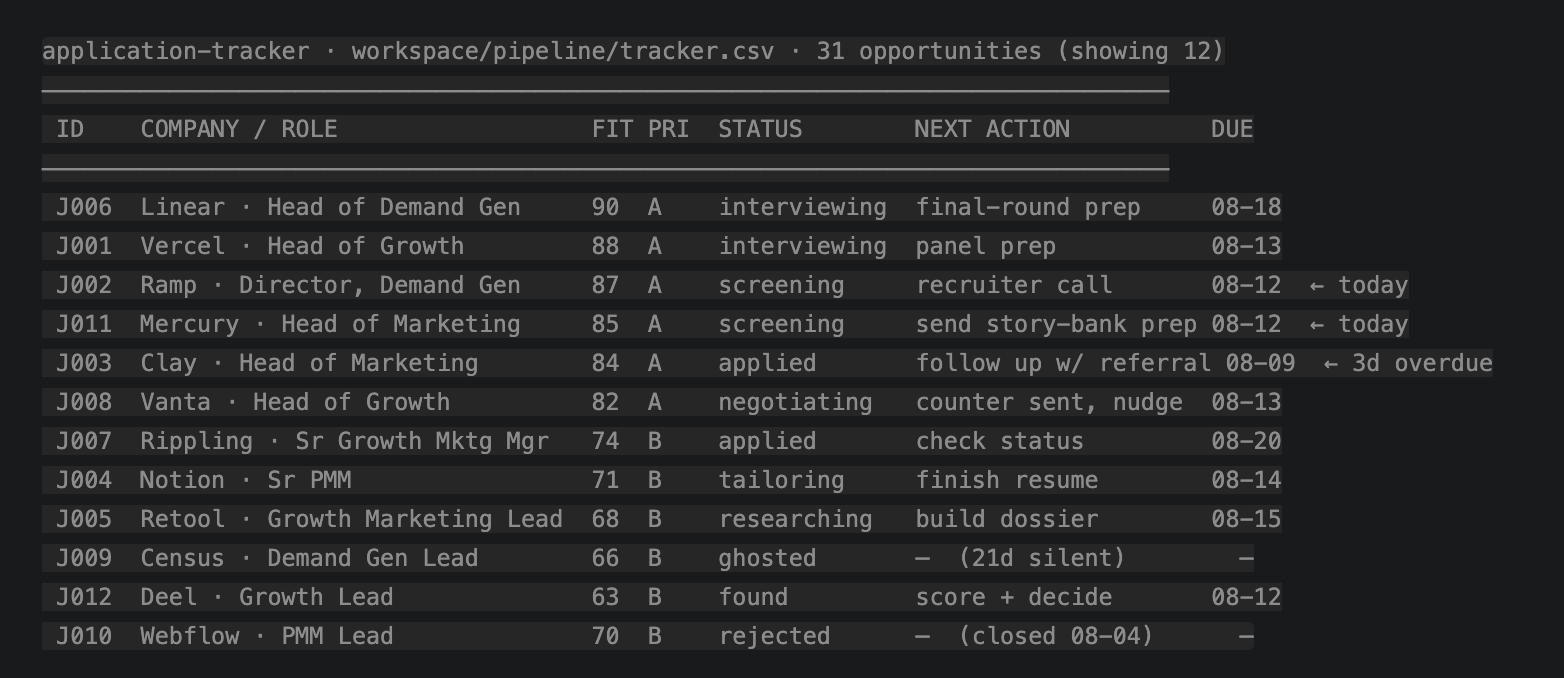
By using this, every job gets a row and a status, plus a running list of what’s due and what’s next, so nothing slips when you’re juggling thirty of them at once. The story-bank skill builds eight to twelve reusable STAR stories that answer almost any behavioral question, and interview-prep pulls those plus the company research into stage-specific question packs and mock rounds. The interview-followup skill drafts a thank-you out inside 24 hours and runs a quick debrief that makes the next interview better than the last.
Record your interviews! I use Granola (my referral link gets you a 2-month business plan for free), and I suggest you do as well to record your calls; then you can send a more tailored follow-up and get interview coaching to improve.
Drop the transcript into interview-debrief and it will grade the round the way a coach would: what did you do well, where can you improve, what to start and stop doing next time, etc. Once you run it a few times, it starts to learn your patterns and can give you even better feedback. This skill then writes your follow-ups from what was actually said, and they will be tailored to the people on the interview (e.g., if you interviewed with the recruiter, it will be tailored to a recruiter, if you interviewed with the hiring manager, it will be tailored to a hiring manager, etc.). Then, all of your best answers get saved to your story bank.
And when you get to the offer stage, offer-negotiation gives you benchmarks, a weighted comparison across competing offers, and actual counter scripts, because, as you know, accepting the first number you get can be the most expensive and costly mistake you make. Trust me, I’ve learned that one the hard way.
Putting it all together into a system
Now, as I said, the first time you run through this from start to end, it’s going to be extremely valuable, but this system is meant to work in a loop, and this is just the beginning.
Run search-and-scale-os and it will read your pipeline and give you one next-best-action. It’s going to evaluate your whole pipeline and if you’re thin on A-fit roles, it will send you back to the sourcing step. If you have scored roles that have not moved to the applied stage, it takes you back to the referrals and tailoring stage. If you have an interview on the calendar, you will get prompted to run research and prep.
You get the idea.
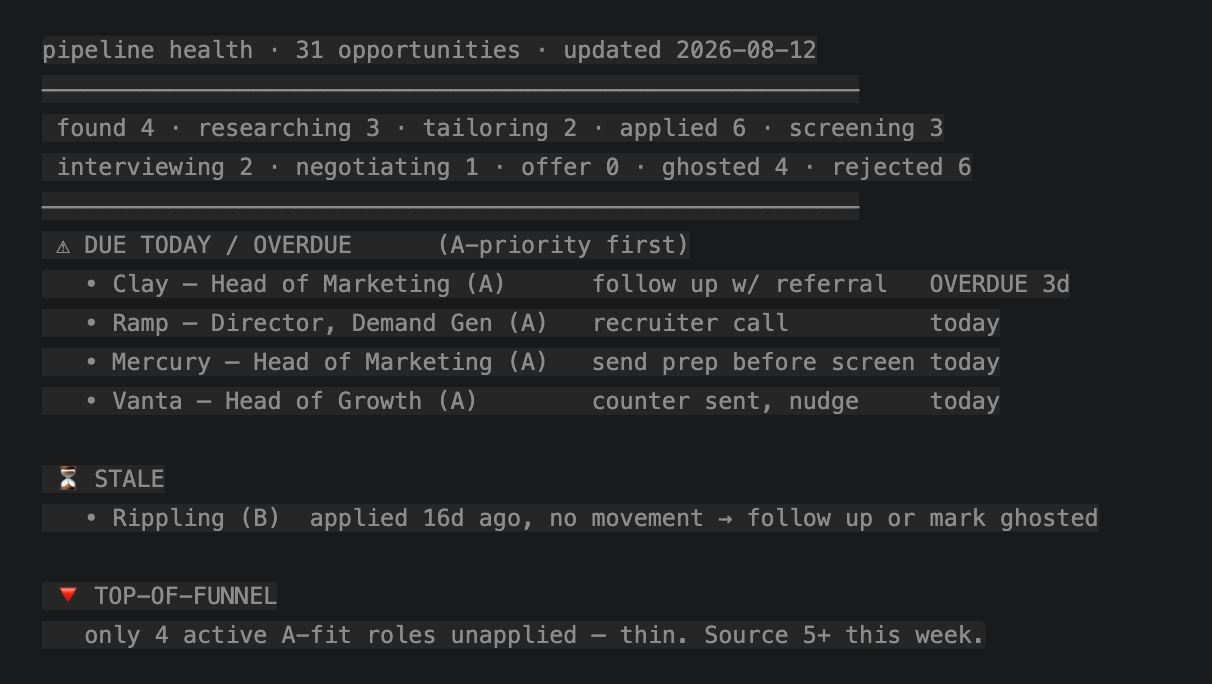
Once a week, it runs a review. It compares what you actually did to the baseline numbers a real search needs to hit each week:
At least 5 new A-fit roles sourced
3 to 5 applications out, each with a referral attempted first
At least 10 outreach touches
Every scheduled interview prepped, every follow-up sent inside 24 hours
Then it checks how well opportunities are moving from one stage to the next and flags the stage where you’re having the most trouble moving through.
Why the quality filters are non-negotiable
I put an eval (like a quality filter) on every piece of writing the system produces because every job hunter right now has access to the same AI tools and models you do. That means the median resume, the median cold note, the median cover letter have all converged on the same voice, the same rhythm, and the same tells.
The writing-quality skill and artifact-eval skill are there to make your writing actually sound like you. When everyone else is using AI, everyone else sounds the same. This will help you sound different. Again, this is just another basic principle of marketing, we’re just applying it to the job search.
Run it this week
Just like in business, the deals you close tomorrow are today’s pipeline. And I built this search and scale OS to help you build that dream job pipeline.
It’s on GitHub, it’s MIT-licensed, and it’s yours to fork: github.com/guerrilla2799/search-and-scale-os.
If it lands you some interviews or even your next job, star the repo so the next person finds it too!